On Liquity V2, 25% of revenues paid by borrowers are collected and redirected to any onchain address, called “Liquidity initiatives”.
Those liquidity initiatives can be liquidity pools (e.g. BOLD-related pools on Uniswap or Curve), rewards for lending protocols, or any address willing to participate in Liquity’s growth, and the PIL rewards amount directed towards those initiatives are chosen by LQTY stakers.

How to participate as a voter
Step 1
To participate as a voter, we have to stake LQTY tokens. The longer the stake, the more stakers have voting power (users can leave anytime without penalty)

Voting Power for 100 staked LQTY:
- Day 0 = 0
- Day 1 = 100
- Day 90 = 9,000
Other examples:
- 500 LQTY (from day 0) at day 90 = 45,000
- 500 LQTY (from day 0) + 100 LQTY (from day 40) at day 90 = 50,000
 When reducing you stake, your voting power is reduced proportionally, whatever the number of stakes and their respective age. In other words, we can’t choose LQTY with a specific age to withdraw.
1. Initial stake = 500 LQTY (from day 0) + 100 LQTY (from day 40)
2. Withdraw 50%
3. New stake = 250 LQTY (from day 0) + 50 LQTY (from day 40)
Step 2
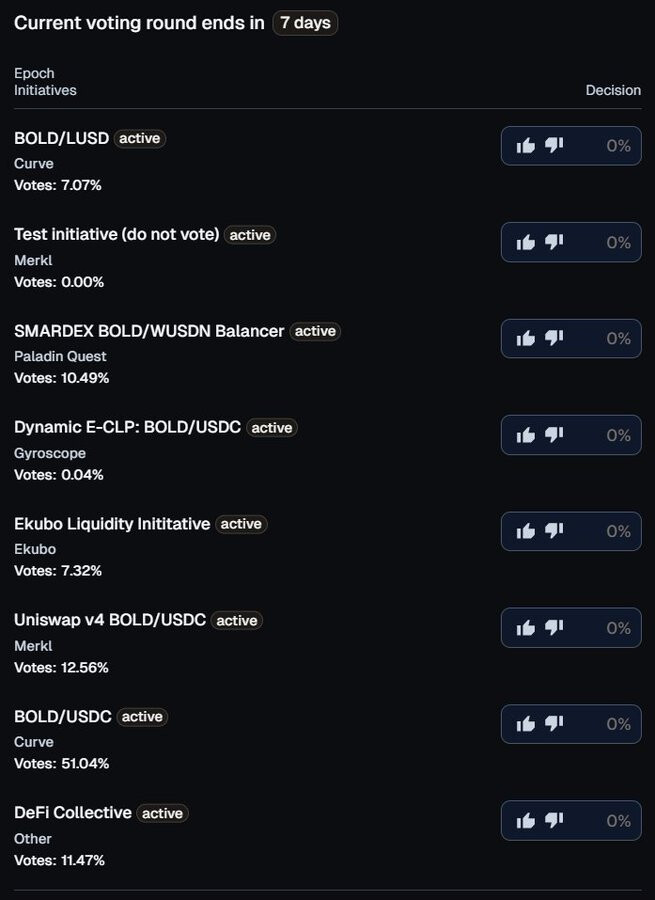
LQTY Stakers can vote or downvote (“veto”) initiatives by giving any percentage of their voting power. Vetoes don’t count for incentives. However, if vetoes > votes, the initiative is unregistered.
Step 3
The voting periods (called “epochs”) start from Thursday (00:00 UTC) to the following Wednesday (23:59:59 UTC). Votes are disabled 24 hours before the end of the epoch and only vetos are available, to avoid last-minute changes or malicious initiatives.
Step 4
Once a user votes, the distribution of votes and vetoes will be saved for future epochs, until users wish to change it.
How to participate as a liquidity initiative
Step 1
Initiatives are permissionless but have a cost. To do so, the proposer must hold at least 0.01% of all voting power and pay a registration fee of 1000 BOLD. These measures have been adopted to prevent spam.
Other stakeholders also can support liquidity initiatives if they’re relevant enough.
Step 2
Any Ethereum address can receive PIL, but the team recommends to create a smart contract containing any logic necessary to direct any received funds in BOLD.
Step 3
Let’s assume that the initiative is eligible for voting. It must reach at least 2% of total votes to qualify for incentives, but they must hurry: Initiatives failing to reach this threshold during four consecutive epochs may be unregistered.
Step 4
At the end of an epoch, all initiatives with at least 2% of total votes get the Protocol-Incentivized Liquidity (PIL), split in proportion to the relative votes

Example with 10,000 BOLD as PIL:
- First initiative (50% vote, 0% veto) = 7,700 BOLD (77% relative votes)
- Second initiative (10% votes, 20% veto) = 0 (vetoed)
- Third initiative (15% vote, 4% veto) = 2,300 BOLD (23% relative votes)
- Fourth initiative (1% vote, 0% veto) = 0 (under 2%)
Beware of sleeping on incentives! They must be claimed in the same week, else they get redistributed to the next epoch. Furthermore, if the weekly claim is not done for more than four consecutive epochs, an initiative can be unregistered.
Bribes: Bribes are payments made by third parties to influence how LQTY stakers vote on PIL allocations (spend x amount as bribe, hoping to get more than x as PIL rewards)
Bribes are permissionless, so no need for any approval to bring incentives for any initiative
Liquity has provided open source Bribe adapters that can be extended and modified by developers.